Media Kit
Press & Media Kit
Everything media professionals, producers, journalists, educators, and event organizers need to feature Nia S. McDaniel and Learning To Conduct, My ADHD Journey.



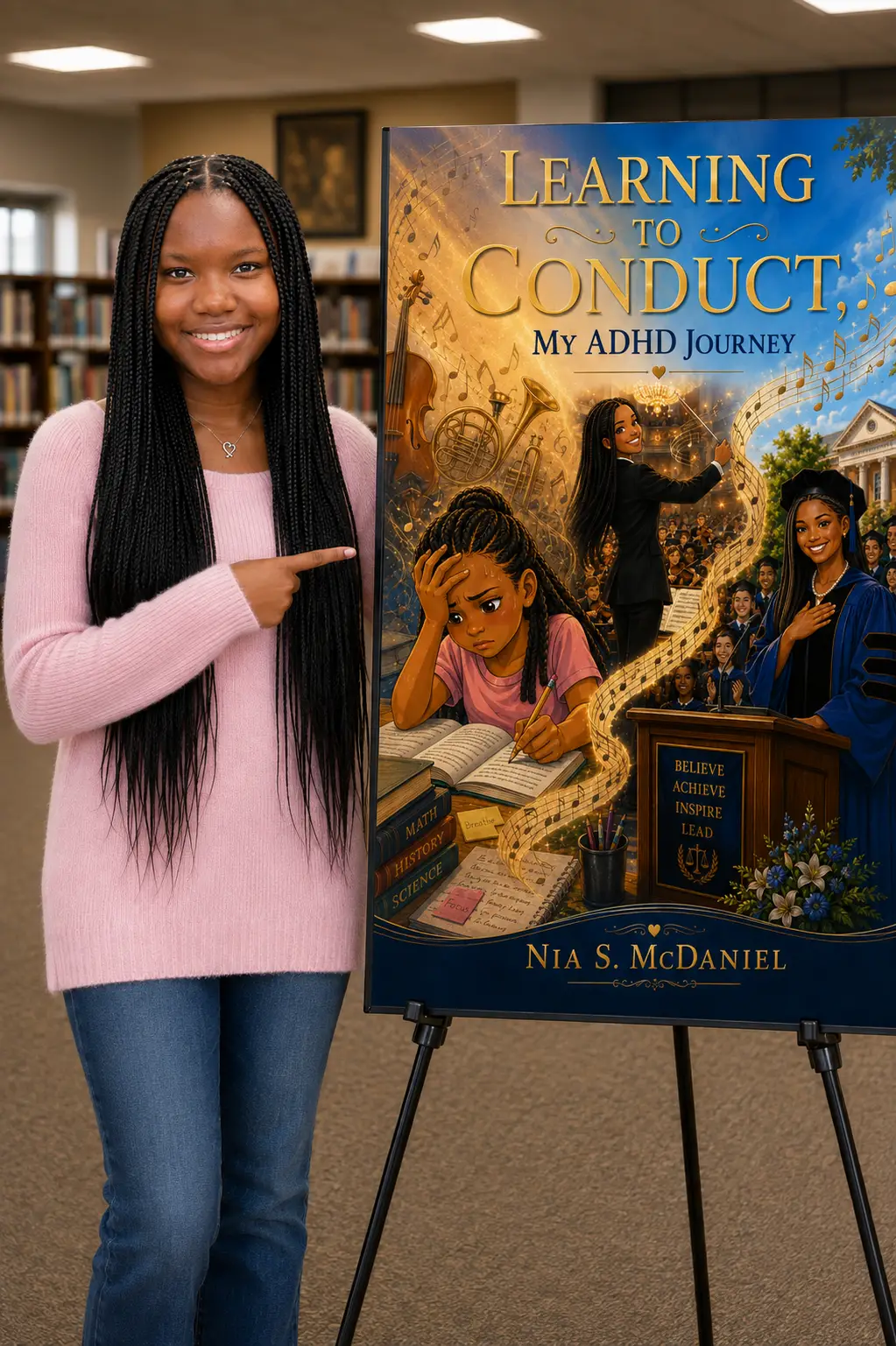
About The Book
50-Word Synopsis
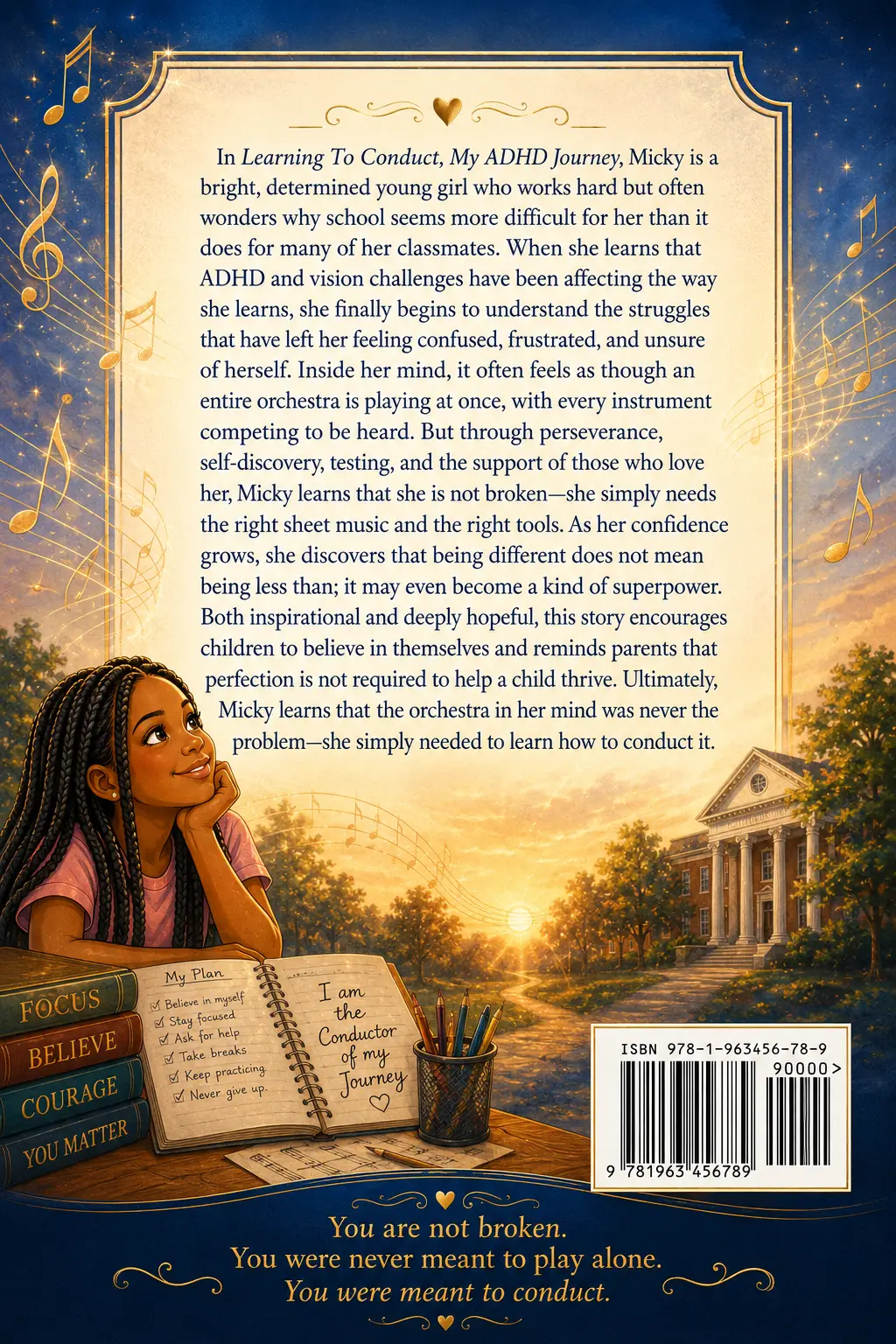
100-Word Synopsis
In Learning To Conduct, My ADHD Journey, a bright and determined girl works harder and harder but cannot understand why school remains so difficult. Inside her mind, thoughts, worries, instructions, and responsibilities seem to compete like instruments playing without shared sheet music. As her confidence begins to fade, she gradually learns that her struggles do not mean she lacks intelligence. Through understanding ADHD, learning differences, and the way her own mind works, she begins developing the tools to direct her orchestra. The substantially autobiographical story offers young readers reassurance, hope, and a path toward self-understanding.
250-Word Synopsis
Micki is bright, hardworking, funny, observant, and determined. She loves learning and wants to succeed, but school often feels far more difficult than she believes it should.
She studies for hours, struggles to begin assignments, loses track of instructions, becomes distracted, and sometimes receives results that do not reflect her effort. As classmates appear to move forward more easily, Micki begins to doubt herself and asking a painful question: “am I not as smart as the other kids in my class?”
Inside her mind, everything feels like an orchestra in which violins, drums, trumpets, thoughts, worries, feelings, and responsibilities are all trying to play at once.
For years, Micki believes she needs to work harder.
What she really needs is understanding.
Learning To Conduct, My ADHD Journey follows her emotional path from confusion and frustration to self-doubt, clarity, self-understanding, and eventually empowerment. As she learns more about ADHD, executive functioning, vision challenges, and the way she learns, Micki begins to understand that her brain is not broken and her struggles are not due to a lack of intelligence, or evidence of failure.
She needed to understand
She needed tools.
She needed support.
She needed the sheet music.
Most of all, she needed to learn how to conduct.
Written by a teenage author and inspired by her own experience, the book offers young readers an accessible story about resilience, confidence, learning differences, family understanding, and realizing one’s potential.
One-page Synopsis
Micki is a bright, determined, empathetic, observant, resilient, musically inclined, and outwardly funny girl who loves learning.
But for much of her childhood, learning does not feel the way she thinks it should.
She works hard—often harder than the people around her realize. She studies for hours, tries to focus, and wants desperately to do well. Yet she sometimes zones out during instructions, struggles to begin assignments, becomes distracted, and performs poorly on tests despite extensive preparation.
As the years pass, confusion becomes frustration.
Frustration becomes self-doubt.
Micki begins comparing herself with classmates who seem to earn better grades with less visible effort. She wonders why working harder is not enough. Eventually, she starts questioning her own intelligence.
The experience feels like an orchestra performing without coordination. Thoughts, feelings, instructions, worries, responsibilities, and distractions all compete for attention. The instruments are not bad. The musicians are not incapable. But without shared sheet music and effective direction, the result can feel overwhelming.
Micki does not yet know that ADHD and related vision challenges are affecting the way she experiences school.
When she finally gains greater understanding, the discovery brings relief. Her difficulties are real, but they do not define her intelligence or limit her potential.
With support, treatment, tools, and self-awareness, Micki begins learning how her brain and eyes work. She develops language for experiences she once interpreted as personal failure.
The music does not disappear.
She learns how to conduct it.
Learning To Conduct, My ADHD Journey is a substantially autobiographical middle-grade story about confusion, perseverance, confidence, learning differences, family understanding, and empowerment.
Written by a teenage author who wanted to create the book she wishes she had received earlier, it offers young readers the reassurance that they are not alone—and reminds adults that understanding can change a child’s story.
Extended Synopsis
At age 17, Micki appears confident, capable, and ready to lead her own orchestra.
But she did not always feel that way.
Looking back on her childhood, she remembers being a bright and curious girl who loved music, cared deeply, worked hard, and wanted to succeed. She also remembers the confusion and frustration of feeling that school demanded more from her than she believed it demanded from other students.
Beginning in her early school years, Micki sometimes misses instructions, drifts away mentally, struggles to begin tasks, becomes distracted, and studies for long periods without receiving the results she expects.
She is intelligent and determined, and her grades are often good enough that adults may not immediately recognize the depth of her struggle. Her ability and effort help her compensate, but compensation has a cost.
Micki begins to believe that if she simply works harder, focuses more, studies longer, or becomes more disciplined, she will finally perform the way she thinks she should.
She keeps trying.
When the results do not change enough, the explanation turns inward.
Perhaps she is not smart enough.
The orchestra metaphor gives shape to Micki’s internal experience. Her mind is filled with instruments—thoughts, emotions, instructions, responsibilities, worries, ideas, and distractions. Each instrument may be meaningful, but they do not always enter at the right time or follow the same score.
Without understanding, the music can feel like noise.
The book follows Micki through public and private school experiences, family conversations, academic pressure, growing self-doubt, and the eventual identification of ADHD and vision challenges.
Her father’s journey is also part of the story. He initially believes that greater effort and focus may solve the problem. Later, he recognizes his delay in understanding and fully supports her efforts to thrive and raise above her ADHD and vision challenges. Her mother is initially more open to the possibility that something else may be happening, but the family must still move gradually toward clarity.
When Micki finally learns that ADHD and related challenges have affected the way she processes school, she experiences something she has needed for years: relief.
The diagnosis does not excuse every difficulty, erase responsibility, or eliminate the need for effort. It gives her a more accurate explanation and access to tools.
She begins learning how her brain works.
She begins learning how her eyes work.
She begins learning how she works.
Treatment and weekly in-person vision therapy become part of her journey. So do practical strategies, support, and increasing self-awareness.
Most importantly, Micki begins rebuilding confidence.
She realizes that the orchestra was never proof that she was incapable. It was evidence that she needed the sheet music and the ability to conduct.
The emotional arc moves deliberately from confusion to frustration, self-doubt, clarity, self-understanding, and empowerment.
By the end, Micki has not become perfect, and every challenge has not disappeared. She has gained something more durable: an understanding of herself.
That understanding changes how she interprets difficulty, asks for support, uses her strengths, and imagines her future.
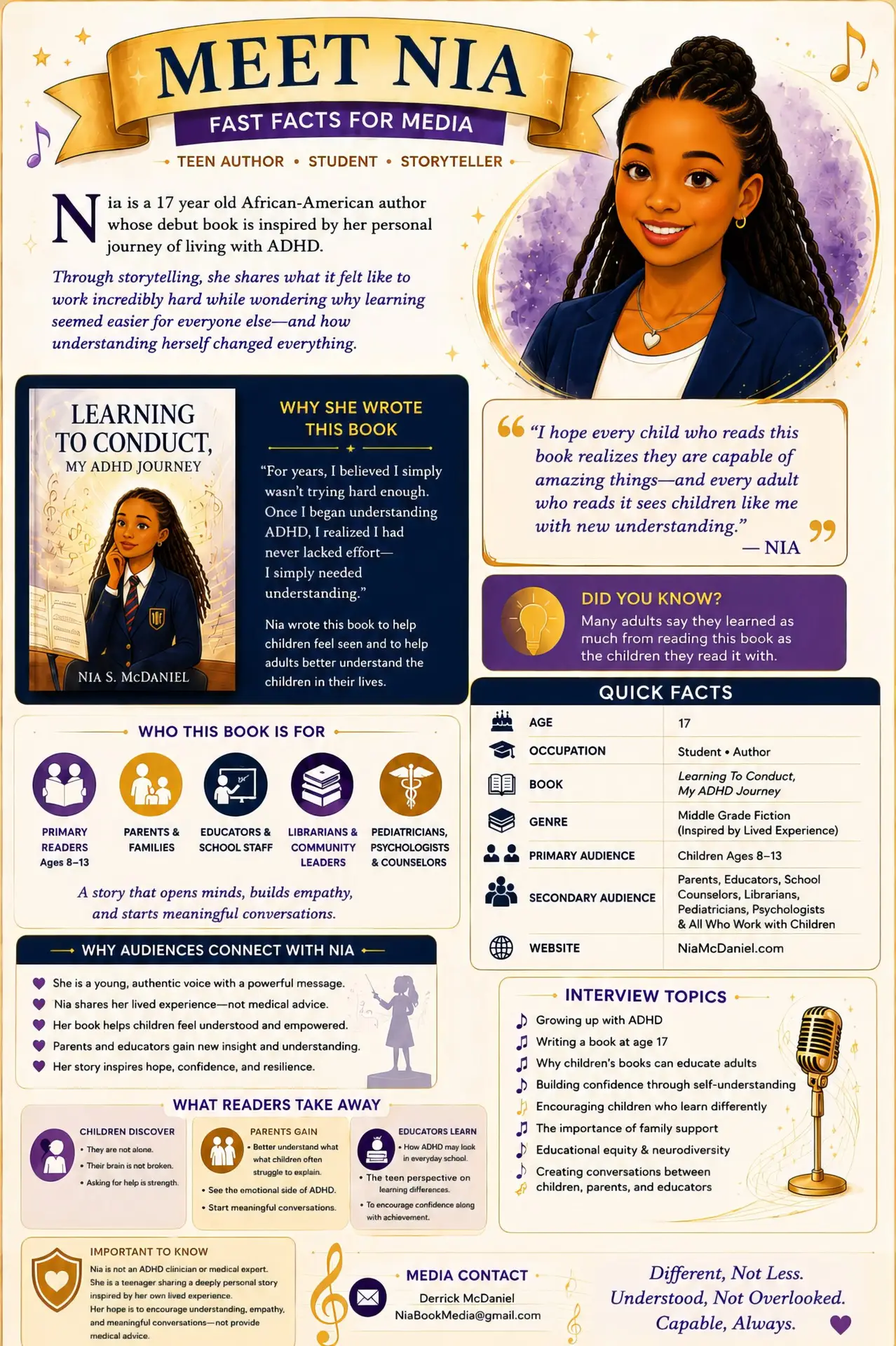
Written by a 17-year-old African American author and inspired substantially by her own life, Learning To Conduct, My ADHD Journey is intended for middle-grade readers while offering important insight to parents, teachers, counselors, and communities.
It is the book Nia wishes someone had given her earlier—a story that tells struggling students:
You are not broken.
You are not alone.
You may simply need understanding, tools, support, and the opportunity to learn how to conduct your own music.
About the Author
50-Word Biography
Nia S. McDaniel is a 17-year-old student, author, and emerging youth advocate from the Northern New Jersey–New York City area. Her book, Learning To Conduct, My ADHD Journey, uses personal storytelling to encourage greater understanding of ADHD, learning differences, resilience, student confidence, and the power of self-understanding.
100-Word Biography
Nia S. McDaniel is a 17-year-old African American high school student, first-time author, and emerging youth advocate from the Northern New Jersey–New York City area. Her substantially autobiographical book, Learning To Conduct, My ADHD Journey, explores ADHD, learning differences, confidence, academic resilience, executive functioning, and self-discovery through the metaphor of an orchestra. Nia wrote the book she wishes someone had given her when she was younger. Through writing, interviews, and public conversations, she hopes to help students feel understood and encourage parents and educators to approach learning differences with greater curiosity, empathy, and hope.
250-Word Biography
Nia S. McDaniel is a 17-year-old African American high school student, first-time author, and emerging national youth voice on resilience, learning differences, education, and realizing potential.
Her book, Learning To Conduct, My ADHD Journey, is a substantially autobiographical middle-grade story inspired by her experience of working hard in school while not fully understanding why learning sometimes felt more difficult than it appeared to be for others. For years, Nia believed she simply needed to try harder. Greater understanding of ADHD, executive functioning, and her own learning experience helped her begin replacing confusion and self-doubt with clarity and self-advocacy.
Using the metaphor of an orchestra, the book follows a young student whose thoughts and responsibilities often seem to compete like instruments playing without shared sheet music or a conductor. The story explores confidence, academic resilience, personal growth, and the importance of understanding how one learns.
Nia wrote the book she wishes she had received when she was younger. She hopes it will help students recognize that struggling does not mean they lack intelligence, and that learning differently does not mean thinking less.
Based in the Northern New Jersey–New York City area, Nia is available for television, radio, podcast, print, digital, school, library, and community interviews and programs. Her broader goal is to help students, parents, and educators have more compassionate and productive conversations about learning differences and student potential.
One-Page Media-Kit Biography
Nia S. McDaniel is a 17-year-old African American high school student, first-time author, and emerging youth advocate whose work opens an important conversation about ADHD, learning differences, resilience, education, and self-understanding.
Her book, Learning To Conduct, My ADHD Journey, draws substantially from her own experience. Nia was bright, determined, and hardworking, but for years she did not understand why academic tasks could require so much effort or why her results did not always reflect the time and energy she invested.
Like many capable students, she initially interpreted the problem personally. She believed she needed to work harder, focus more, or somehow become the kind of student for whom school appeared easier.
Understanding ADHD and the way she learned changed the story she was telling herself.
Instead of seeing difficulty as evidence that she was not intelligent enough, Nia began to understand the role of executive functioning, attention, learning differences, and the need for appropriate tools and support.
She transformed that experience into a book for younger readers.
Using the metaphor of an orchestra, Learning To Conduct, My ADHD Journey portrays a mind filled with thoughts, feelings, responsibilities, questions, and competing demands each like an instrument trying to play at the same time. The story’s central insight is not that the music must disappear. It is that the student needs understanding, tools, and the ability to conduct it.
Nia wrote the book she wishes someone had placed in her hands when she was younger.
Her public message is hopeful but realistic: learning differently does not mean thinking less, and students should not mistake confusion for inability or difference for failure.
Nia is comfortable participating in television, podcast, radio, print, digital, school, library, and public-speaking opportunities. She is available for interviews in person, by video, or by telephone.
Through storytelling and public engagement, Nia hopes to help young people feel less alone while encouraging parents, educators, and communities to listen more closely to students whose struggles may not be immediately visible.
Extended Professional Profile
Nia S. McDaniel is a 17-year-old African American high school student, author, student advocate, and emerging national youth voice on resilience, learning differences, education, ADHD awareness, and realizing potential.
Her debut book, Learning To Conduct, My ADHD Journey, grew from an intensely personal question: What happens when a bright and hardworking student believes her continuing struggles mean that she is not intelligent enough?
For years, Nia worked hard but did not fully understand why academic tasks could require so much time and energy. She experienced challenges involving attention, task initiation, distraction, test performance, confidence, and the disconnect between effort and results. Because those difficulties were not initially understood, she often interpreted them as personal shortcomings.
The eventual recognition of ADHD and related learning challenges provided more than a label. It provided language, context, and relief.
Nia began to understand that she was not incapable and that her brain was not broken. She needed appropriate tools, support, and a clearer understanding of how she learned.
That realization became the foundation of Learning To Conduct, My ADHD Journey.
The book uses music and the orchestra as its central metaphor. Thoughts, responsibilities, feelings, fears, and distractions are portrayed as instruments. Without shared sheet music or effective direction, even talented musicians can create noise rather than harmony. The story shows a young person gradually learning that she does not need to silence every instrument. She needs to understand the music and become its conductor.
Although written for middle-grade readers, the book has broader relevance for parents, teachers, school counselors, school psychologists, ADHD professionals, and anyone who supports children whose intelligence may be obscured by unidentified or misunderstood learning challenges.
Nia’s public identity extends beyond the book. She is developing as a thoughtful youth communicator whose personal experience provides an accessible entry point into larger conversations about education, confidence, neurodiversity, self-advocacy, and the importance of listening to students.
She does not present herself as a clinician or claim to speak for every individual with ADHD. Her authority comes from authentic lived experience, reflection, and her willingness to use her story to help others.
Nia For Interviews
Primary Positioning Statement
Nia S. McDaniel is a 17-year-old author, student advocate, and emerging national youth voice. Her book, Learning To Conduct, My ADHD Journey, creates an accessible entry point into important conversations about resilience, learning differences, education, ADHD awareness, student confidence, and realizing potential. She helps students, parents, educators, and communities better understand ADHD and the power of self-understanding through authentic storytelling.
Secondary Positioning Statement
Through her substantially autobiographical book, Learning To Conduct, My ADHD Journey, Nia transforms years of academic confusion and self-doubt into a hopeful message for young people: learning differently does not mean lower ability or thinking less; and understanding how you learn can change what you believe is possible.
Media Positioning(Short)
“Nia is an emerging national youth voice whose book creates an accessible entry point into important conversations about resilience, learning differences, education, ADHD awareness, student confidence, and realizing potential.”
*** Nia should never be positioned merely as a teenager who wrote a book, nor as a Clinical Expert on ADHD ***
Why Nia Is An Outstanding Interview Guest
School Visits & Speaking
Fact Sheet
Learning To Conduct, My ADHD Journey
Format
Paperback / Ebook
Genre
Middle-grade autobiographical fiction
Primary Age
Ages 7–12
Author
Nia S. McDaniel
Secondary Audiences
- Parents and caregivers
- Teachers
- School counselors
- School psychologists
- ADHD professionals
- Pediatric and behavioral-health professionals
- Education students and faculty
- Youth-serving organizations
Book Overview
Learning To Conduct, My ADHD Journey follows a bright, determined, and musically inclined girl who works hard in school but does not understand why learning often feels more difficult for her than it appears to be for others.
Through the metaphor of an orchestra, the story illustrates what it can feel like when thoughts, instructions, worries, responsibilities, and distractions all compete for attention.
The protagonist’s journey moves from confusion and frustration to self-doubt, clarity, self-understanding, and empowerment. She gradually learns that the problem is not a lack of intelligence or effort. She needs greater understanding of how she learns, appropriate tools, and the confidence to “conduct her own orchestra” (metaphor for how the author’s brain works-how she learns & understands).
Book Overview
ADHD
ADHD in girls
ADHD in African American girls
Learning differences
Executive functioning
Confidence
Academic resilience
Self-discovery
Student empowerment
Family understanding
ADHD
Educational success
Educational Relevance
The book may help readers and adults discuss:
- Why a capable student may still struggle
- The emotional effects of unidentified learning challenges
- How self-doubt develops
- How attention and executive functioning affect schoolwork
- Why effort may not always be reflected in grades
- The importance of testing, evaluation, and support
- How families respond to learning differences
- How students develop self-awareness and self-advocacy
- Why stories can make complex experiences easier to discuss
Learning Objectives
After reading and discussing the book, readers should be better able to:
- Recognize that students can be intelligent and hardworking while still experiencing significant learning challenges.
- Understand that ADHD may affect attention, organization, task initiation, memory, and emotional confidence.
- Identify the difference between personal failure and an unmet need for understanding or support.
- Discuss the importance of communicating with trusted adults.
- Explain how self-understanding can support confidence and resilience.
- Appreciate that students learn in different ways.
- Recognize the value of empathy in classrooms and families.
Discussion Topics
- What does the orchestra represent?
- Why does the protagonist initially blame herself?
- How can adults misunderstand a hardworking student?
- What changes when the protagonist gains clarity?
- How does language affect self-confidence?
- What does it mean to “need the sheet music”?
- What tools help people conduct their thoughts and responsibilities?
- How can classmates support students who learn differently?
- What can parents and teachers learn by listening more carefully?
Ideal Settings
- Independent reading
- Family reading
- Classroom discussion
- School counseling
- Library programming
- Book clubs
- ADHD-awareness events
- Parent education
- Teacher professional development
- Youth-leadership conversations
WHY EDUCATORS SHOULD CARE
The book offers a student-centered narrative that can help educators better understand the internal experience of a capable learner whose effort may not be obvious from her performance.
It can support discussions about empathy, classroom observation, student confidence, and the need to look beyond assumptions.
WHY PARENTS SHOULD CARE
Parents may recognize behaviors that are easy to interpret asinsufficient effort, carelessness, poor motivation, orlaziness. The story encourages families to ask what a child may be experiencing before deciding why the child is struggling.
WHY STUDENTS SHOULD CARE
The story gives students language for feelings they may not know how to explain. It reassures them that difficulty is not proof of low intelligence and encourages them to seek understanding and support.
Key Differentiators
- Written by a teenage author
- Substantially autobiographical
- Centers an African American girl
- Uses an orchestra metaphor to make complex experiences accessible
- Combines story, emotional growth, and educational relevance
- Speaks directly to students while remaining useful to adults
- Emphasizes understanding rather than deficit
- Presents a realistic journey from confusion to empowerment
Key Differentiators
Publisher: Independently published
Publication date: June 24, 2026
ISBN: 979-8199454650
Page count: 43 pages
Trim size: 5.5” x 8.5”
Formats: Paperback
Retail price: $8RETAIL AVAILABILITY
- Amazon: https://amoz.onl/6hM
- Author website: NiaMcDaniel.com/Purchase
- Other retailers: [Links]
- Library or institutional ordering: [Instructions]
Frequently Asked Questions (FAQs)
Why did you decide to write this book?
For years I believed I simply needed to try harder. Once I began understanding how ADHD affected me, everything started making more sense. I wanted other children to know they are not alone—and I wanted adults to better understand what many children experience every day.
Is this book autobiographical?
It is inspired by my own experiences, thoughts, and emotions. While some details have been adapted for storytelling, the feelings, challenges, and hope throughout the book come from a very real place-my lived experiences.
Why is the title learning to conduct?
The orchestra became a metaphor for how my mind often felt—many thoughts competing for attention at the same time. The “sheet music” represents understanding. Once I began understanding how my brain worked, life and school became much easier to navigate. I became the Conductor.
Who is this book really written for?
Children are the primary audience, but I believe parents, teachers, school counselors, librarians, doctors, and anyone who works with children will find it educational. Many adults tell me they learned something by reading it themselves.
You aren't an ADHD expert. Why write a book about ADHD?
I’m not trying to teach the science of ADHD. I’m sharing what it felt like to live through it. My hope is that my story helps start conversations and encourages people to better understand children who learn differently.
What do you hope children take away from this book?
I hope they realize they are not broken. Struggling does not mean they are less intelligent or less capable. Sometimes children simply need the right understanding, support, and tools.
What do you hope adults learn from reading this book?
Children often work much harder than adults realize. A child who appears distracted or frustrated mightactually be trying incredibly hard. Understanding what a child is experiencing can completely change how people respond to them.
Why do you think this story resonates with so many people?
Because almost everyone has experienced self-doubt. Whether or not someone has ADHD, many people know what it feels like to work hard, compare themselves to others, and wonder if they’re enough.
What surprised you most while writing the book?
I realized how many emotions I had carried for years without fully understanding them. Writing the book helped me understand my own journey in a much different way.
If readers remember only one message from the book, what do you hope it is?
Understanding yourself changes everything. Once we understand how we learn and how we think, we stop asking, “What’s wrong with me?” and start asking, “What helps me succeed?”
Why is this book important now?
Presently, more families and schools are talking openly about learning differences and mental health. I hope this book helps make those conversations easier, kinder, and more hopeful.
What's next for you?
Right now I’m excited to continue sharing this story with readers. I hope to visit schools, libraries, and communities, meet young readers, and encourage children to believe that their differences can become strengths.