The Book
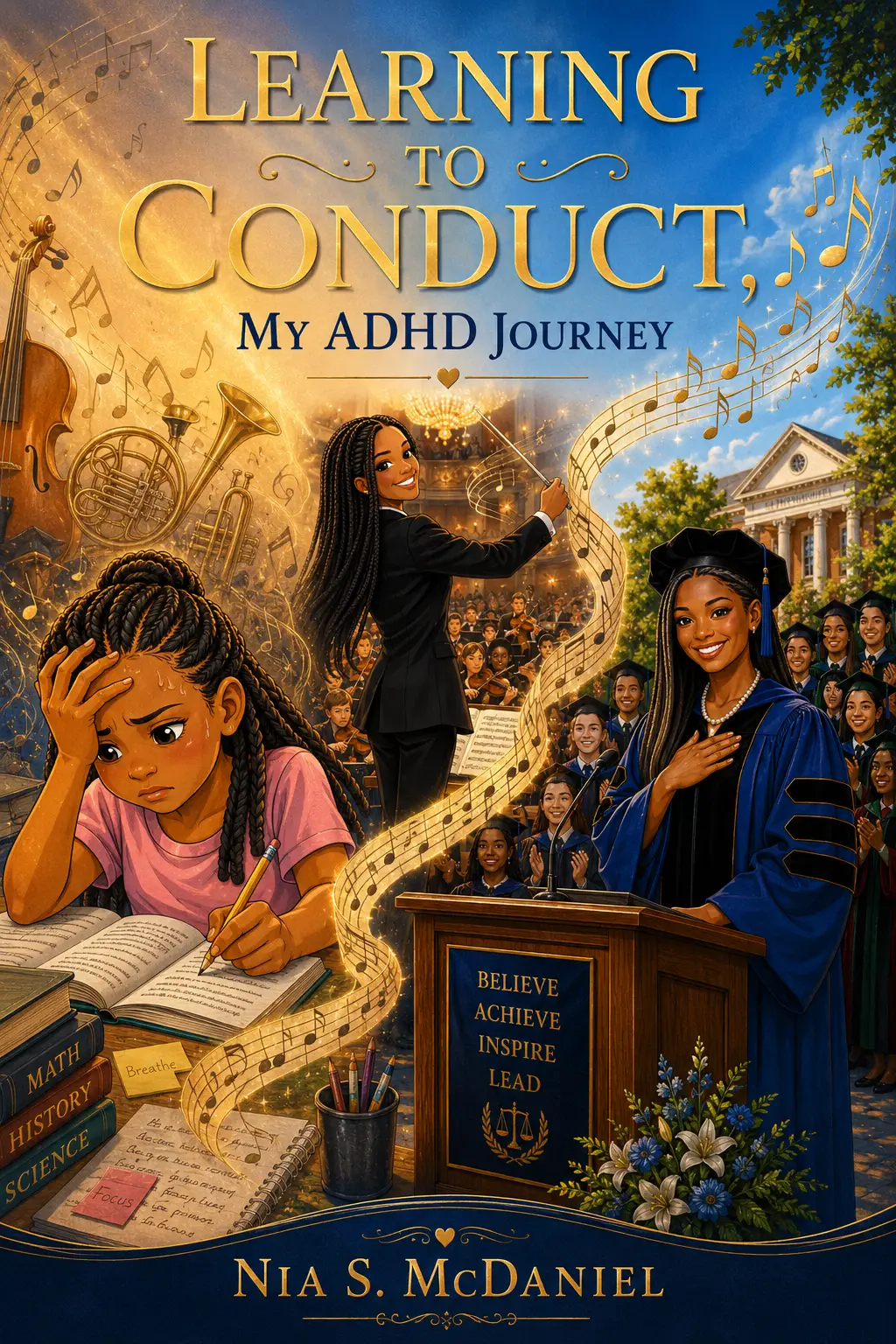
Learning To Conduct, My ADHD Journey
Format
Paperback / Ebook
Genre
Middle-grade autobiographical fiction
Primary Age
Ages 7–12
Author
Nia S. McDaniel
Book Overview
Learning To Conduct, My ADHD Journey follows a bright, determined, and musically inclined girl who works hard in school but does not understand why learning often feels more difficult for her than it appears to be for others.
Through the metaphor of an orchestra, the story illustrates what it can feel like when thoughts, instructions, worries, responsibilities, and distractions all compete for attention.
The protagonist’s journey moves from confusion and frustration to self-doubt, clarity, self-understanding, and empowerment. She gradually learns that the problem is not a lack of intelligence or effort. She needs greater understanding of how she learns, appropriate tools, and the confidence to “conduct her own orchestra.”
Synopses
50-Word Synopsis
A bright, hardworking girl cannot understand why school feels harder for her than it seems to feel for others. Using an orchestra as a metaphor for her busy mind, Learning To Conduct, My ADHD Journey follows her path from confusion and self-doubt to understanding, resilience, and empowerment.
100-Word Synopsis
In Learning To Conduct, My ADHD Journey, a bright and determined girl works harder and harder but cannot understand why school remains so difficult. Inside her mind, thoughts, worries, instructions, and responsibilities seem to compete like instruments playing without shared sheet music. As her confidence begins to fade, she gradually learns that her struggles do not mean she lacks intelligence. Through understanding ADHD, learning differences, and the way her own mind works, she begins developing the tools to direct her orchestra. The substantially autobiographical story offers young readers reassurance, hope, and a path toward self-understanding.
250-Word Synopsis
Micki is bright, hardworking, funny, observant, and determined. She loves learning and wants to succeed, but school often feels far more difficult than she believes it should.
She studies for hours, struggles to begin assignments, loses track of instructions, becomes distracted, and sometimes receives results that do not reflect her effort. As classmates appear to move forward more easily, Micki begins to doubt herself and asking a painful question: “am I not as smart as the other kids in my class?”
Inside her mind, everything feels like an orchestra in which violins, drums, trumpets, thoughts, worries, feelings, and responsibilities are all trying to play at once.
For years, Micki believes she needs to work harder.
What she really needs is understanding.
Learning To Conduct, My ADHD Journey follows her emotional path from confusion and frustration to self-doubt, clarity, self-understanding, and eventually empowerment. As she learns more about ADHD, executive functioning, vision challenges, and the way she learns, Micki begins to understand that her brain is not broken and her struggles are not due to a lack of intelligence, or evidence of failure.
She needed to understand
She needed tools.
She needed support.
She needed the sheet music.
Most of all, she needed to learn how to conduct.
Written by a teenage author and inspired by her own experience, the book offers young readers an accessible story about resilience, confidence, learning differences, family understanding, and realizing one’s potential.
One-page Synopsis
Micki is a bright, determined, empathetic, observant, resilient, musically inclined, and outwardly funny girl who loves learning.
But for much of her childhood, learning does not feel the way she thinks it should.
She works hard—often harder than the people around her realize. She studies for hours, tries to focus, and wants desperately to do well. Yet she sometimes zones out during instructions, struggles to begin assignments, becomes distracted, and performs poorly on tests despite extensive preparation.
As the years pass, confusion becomes frustration.
Frustration becomes self-doubt.
Micki begins comparing herself with classmates who seem to earn better grades with less visible effort. She wonders why working harder is not enough. Eventually, she starts questioning her own intelligence.
The experience feels like an orchestra performing without coordination. Thoughts, feelings, instructions, worries, responsibilities, and distractions all compete for attention. The instruments are not bad. The musicians are not incapable. But without shared sheet music and effective direction, the result can feel overwhelming.
Micki does not yet know that ADHD and related vision challenges are affecting the way she experiences school.
When she finally gains greater understanding, the discovery brings relief. Her difficulties are real, but they do not define her intelligence or limit her potential.
With support, treatment, tools, and self-awareness, Micki begins learning how her brain and eyes work. She develops language for experiences she once interpreted as personal failure.
The music does not disappear.
She learns how to conduct it.
Learning To Conduct, My ADHD Journey is a substantially autobiographical middle-grade story about confusion, perseverance, confidence, learning differences, family understanding, and empowerment.
Written by a teenage author who wanted to create the book she wishes she had received earlier, it offers young readers the reassurance that they are not alone—and reminds adults that understanding can change a child’s story.
Extended Synopsis
At age 17, Micki appears confident, capable, and ready to lead her own orchestra.
But she did not always feel that way.
Looking back on her childhood, she remembers being a bright and curious girl who loved music, cared deeply, worked hard, and wanted to succeed. She also remembers the confusion and frustration of feeling that school demanded more from her than she believed it demanded from other students.
Beginning in her early school years, Micki sometimes misses instructions, drifts away mentally, struggles to begin tasks, becomes distracted, and studies for long periods without receiving the results she expects.
She is intelligent and determined, and her grades are often good enough that adults may not immediately recognize the depth of her struggle. Her ability and effort help her compensate, but compensation has a cost.
Micki begins to believe that if she simply works harder, focuses more, studies longer, or becomes more disciplined, she will finally perform the way she thinks she should.
She keeps trying.
When the results do not change enough, the explanation turns inward.
Perhaps she is not smart enough.
The orchestra metaphor gives shape to Micki’s internal experience. Her mind is filled with instruments—thoughts, emotions, instructions, responsibilities, worries, ideas, and distractions. Each instrument may be meaningful, but they do not always enter at the right time or follow the same score.
Without understanding, the music can feel like noise.
The book follows Micki through public and private school experiences, family conversations, academic pressure, growing self-doubt, and the eventual identification of ADHD and vision challenges.
Her father’s journey is also part of the story. He initially believes that greater effort and focus may solve the problem. Later, he recognizes his delay in understanding and fully supports her efforts to thrive and raise above her ADHD and vision challenges. Her mother is initially more open to the possibility that something else may be happening, but the family must still move gradually toward clarity.
When Micki finally learns that ADHD and related challenges have affected the way she processes school, she experiences something she has needed for years: relief.
The diagnosis does not excuse every difficulty, erase responsibility, or eliminate the need for effort. It gives her a more accurate explanation and access to tools.
She begins learning how her brain works.
She begins learning how her eyes work.
She begins learning how she works.
Treatment and weekly in-person vision therapy become part of her journey. So do practical strategies, support, and increasing self-awareness.
Most importantly, Micki begins rebuilding confidence.
She realizes that the orchestra was never proof that she was incapable. It was evidence that she needed the sheet music and the ability to conduct.
The emotional arc moves deliberately from confusion to frustration, self-doubt, clarity, self-understanding, and empowerment.
By the end, Micki has not become perfect, and every challenge has not disappeared. She has gained something more durable: an understanding of herself.
That understanding changes how she interprets difficulty, asks for support, uses her strengths, and imagines her future.
Written by a 17-year-old African American author and inspired substantially by her own life, Learning To Conduct, My ADHD Journey is intended for middle-grade readers while offering important insight to parents, teachers, counselors, and communities.
It is the book Nia wishes someone had given her earlier—a story that tells struggling students:
You are not broken.
You are not alone.
You may simply need understanding, tools, support, and the opportunity to learn how to conduct your own music.
Primary Themes
ADHD
ADHD in girls
ADHD in African American girls
Learning differences
Executive functioning
Confidence
Academic resilience
Self-discovery
Student empowerment
Family understanding
ADHD
Educational success
Audiences
Primary target age: 7–12
Secondary audiences: Parents and caregivers, teachers, school counselors, school psychologists, ADHD professionals, pediatric and behavioral-health professionals, education students and faculty, and youth-serving organizations.
Learning Objectives
- Recognize that students can be intelligent and hardworking while still experiencing significant learning challenges.
- Understand that ADHD may affect attention, organization, task initiation, memory, and emotional confidence.
- Identify the difference between personal failure and an unmet need for understanding or support.
- Discuss the importance of communicating with trusted adults.
- Explain how self-understanding can support confidence and resilience.
- Appreciate that students learn in different ways.
- Recognize the value of empathy in classrooms and families.
Discussion Topics
- What does the orchestra represent?
- Why does the protagonist initially blame herself?
- How can adults misunderstand a hardworking student?
- What changes when the protagonist gains clarity?
- How does language affect self-confidence?
- What does it mean to “need the sheet music”?
- What tools help people conduct their thoughts and responsibilities?
- How can classmates support students who learn differently?
- What can parents and teachers learn by listening more carefully?